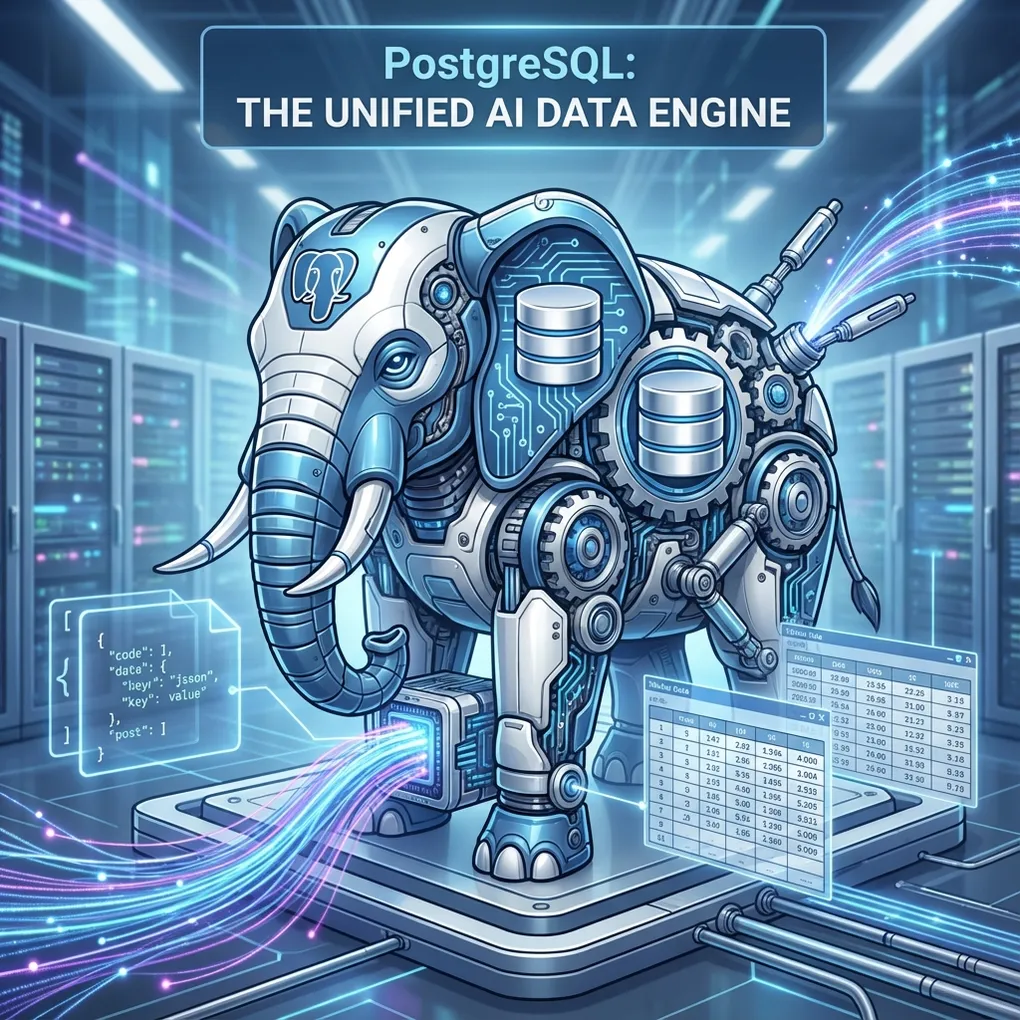
Postgres for Everything: The Only Database You Need for AI
In the early days of the AI boom (circa 2023-2024), the standard advice was to build a “Modern AI Stack”:
- Pinecone/Weaviate for vectors
- MongoDB for unstructured metadata
- Postgres for user data
- Redis for chat history
Suddenly, you’re maintaining four database technologies just to build a chatbot. This is what we call “Infrastructure Sprawl.”
In 2026, the pendulum has swung back. The winning architecture is boring, reliable, and powerful: Just use Postgres.
The “Postgres for Everything” Philosophy
The argument is simple: PostgreSQL is extensible enough to handle every part of the AI lifecycle, and the operational simplicity of a single database outweighs the marginal performance gains of specialized tools.
1. Vectors are just another Data Type (pgvector)
With the pgvector extension, embeddings are first-class citizens in Postgres.
SELECT id, content, 1 - (embedding <=> '[0.1, 0.3, ...]') AS cosine_similarity
FROM documents
ORDER BY cosine_similarity DESC
LIMIT 5;
You don’t need a separate network call to a vector DB. You can JOIN your vector search results directly with your relational user data (e.g., “Find similar documents, BUT only where user_id = 5”). This “Hybrid Search” is painful in distributed systems but trivial in Postgres.
2. JSONB for Flexible Schemas
AI applications often deal with unpredictable data structures—LLM outputs, tool parameters, conversations. Postgres’s JSONB data type (binary JSON) allows you to store unstructured data with document-store agility while keeping the ACID guarantees of a relational DB.
3. AI Inside the Database (pgai)
New extensions like pgai allow you to call LLM models direction from SQL.
SELECT pgai.inference('llama-3-8b', prompt) FROM inputs;Imagine generating embeddings or summarizing text via a trigger inside the database. The data never leaves the secure perimeter of your DB server.
When to actually use a Vector DB?
Is Pinecone dead? No. If you have:
- 100 Million+ vectors
- 10,000 queries per second (QPS)
- Zero relational filtering needs
Then yes, a specialized index like Weaviate or Milvus makes sense. But for 99% of internal RAG apps, customer support bots, and agent startups, Postgres handles the load while letting you sleep at night.
Conclusion
Complexity is the enemy of velocity. By collapsing your stack into PostgreSQL, you eliminate synchronization bugs, reduce latency, and simplify backups.
Stop fetching data from three different places. Put it all in the Elephant.